ElevenLabs Voice Isolator vs. Descript Studio Sound: Real Credit Cost, dBFS Noise Floor & Audio Test
A controlled 70-second, 4-noise benchmark comparing exact credit ledgers, dBFS waveforms, free-tier export limits, and a surprising clipping trap in Descript’s intensity slider.
Most AI audio cleanup comparisons stop at “both sound pretty clean.” That doesn’t help when you’re budgeting monthly credits or deciding whether a free tier actually lets you export a usable file.
To get exact numbers instead of vague impressions, I built a reproducible 70-second, 4-noise benchmark clip using real human speech and ran the exact same file through ElevenLabs Voice Isolator and Descript Studio Sound on free-tier accounts. I logged every credit burned, measured the silence noise floor and true peak levels in Python, and tested what actually happens when you tweak Descript’s intensity slider.
Three findings stood out immediately:
- Noise removal depth: ElevenLabs dropped the noise floor 16.29 dB deeper than Descript at 100% (
-88.61 dBFSvs.-72.32 dBFS) with zero clipping. - Descript’s slider surprise: Adjusting Descript’s Studio Sound slider from
100%to75%costs zero extra AI credits—because it acts as a dry/wet blend. The catch? Blending the raw track back in spiked the True Peak to+1.6 dBFS(37 clipped samples) and raised the silence floor back to-35.87 dBFS. - Free-tier export friction: ElevenLabs gave me a clean, watermark-free 320 kbps MP3, WAV, or FLAC download in one click. Descript paywalled Timeline export, failed on local browser WASM export, and forced a cloud-publish workaround for a
~160 kbpsM4A.
The Controlled 70-Second, 4-Noise Stress Test
Instead of relying on a one-off room recording nobody can reproduce, I sourced a real human microphone reading from a public-domain LibriVox audiobook (Scarhaven Keep, Chapter 1—no synthetic TTS) and mixed a 70.034-second (1.07 MiB, 44.1 kHz mono 128 kbps MP3) benchmark track with four real-world creator noise profiles (seed = 20261125, active speech normalized to -20.0 dBFS RMS):
- 0:00–0:16 (Steady fan/AC hum): Low-frequency pink noise (
80–260 Hz) plus120/180 Hzmotor harmonics at~7.0 dBSNR. - 0:16–0:18 (2-second pure noise window): Speech paused completely so Python could measure exact silence noise floor reduction (
-28.52 dBFSRMS baseline). - 0:18–0:36 (Keyboard & mouse clicks):
93sharp transient pulses (10–22 ms,1.6–7.5 kHz) sitting right across vocal consonant frequencies. - 0:36–0:54 (Cafe / street chatter): Fluctuating mid-band interference (
320–3,400 Hz,~7.5 dBSNR). - 0:54–1:10 (Room reverb + soft tails): Small-room reverb (
RT60 ≈ 0.45s,35%wet) combined with a-2 dBto-6 dBvocal fade to test whether aggressive gates swallow quiet endings.
Both platforms received the exact same raw-noisy-test.mp3 file—no pre-EQ, no trimming.
Billing & Workflow Ledger: Linear Credits vs. Dual Metering
ElevenLabs and Descript charge in completely different ways, which changes which tool is cheaper depending on how long your recordings are.
Metric ElevenLabs Voice Isolator Descript Studio Sound (Free)
-----------------------------------------------------------------------------------------------------------
Account Tier Free (10,000 credits/mo) Free (60 Media min/mo + 100 lifetime AI credits)
Balance Before 3,731 credits 0/60 min | 0/100 AI credits
Balance After 2,564 credits 1/60 min (58m left) | 3/100 AI credits (97 left)
Actual Cost (70s clip) 1,167 credits 1m10s Media + 3 AI credits
Effective Burn Rate ~1,000 credits / min ~2.57 AI credits / min + media quota
Processing Time ~52s E2E UI (~7.7s server) ~75.9s upload/transcribe + ~13.2s Studio Sound
Intensity Slider None (single-click fixed) Yes (default 70%; 100% & 75% cost 0 extra credits)
Free Export Direct MP3 (320k), WAV, FLAC Timeline paywalled; local WASM export failed
(no watermark) (status=0); cloud publish gave ~160k M4A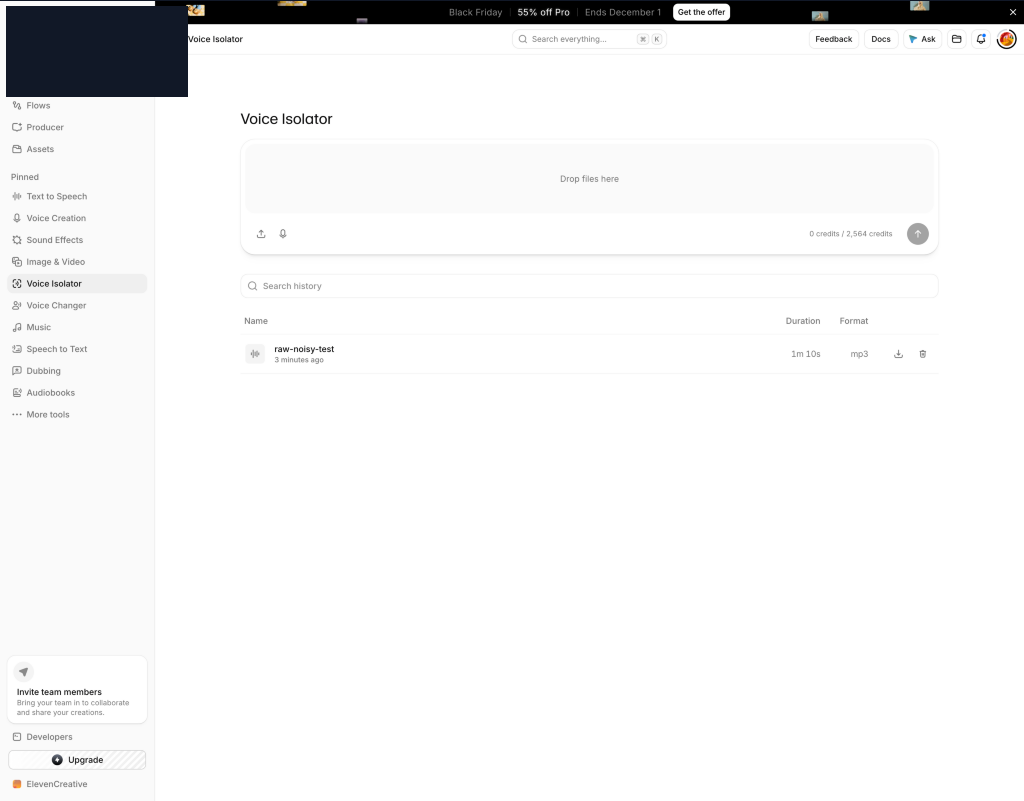 ElevenLabs Voice Isolator deducted an exact 1,167 credits for the 70-second clip (matching the 1,000 credits/minute rate) and unlocked direct MP3, WAV, and FLAC downloads.
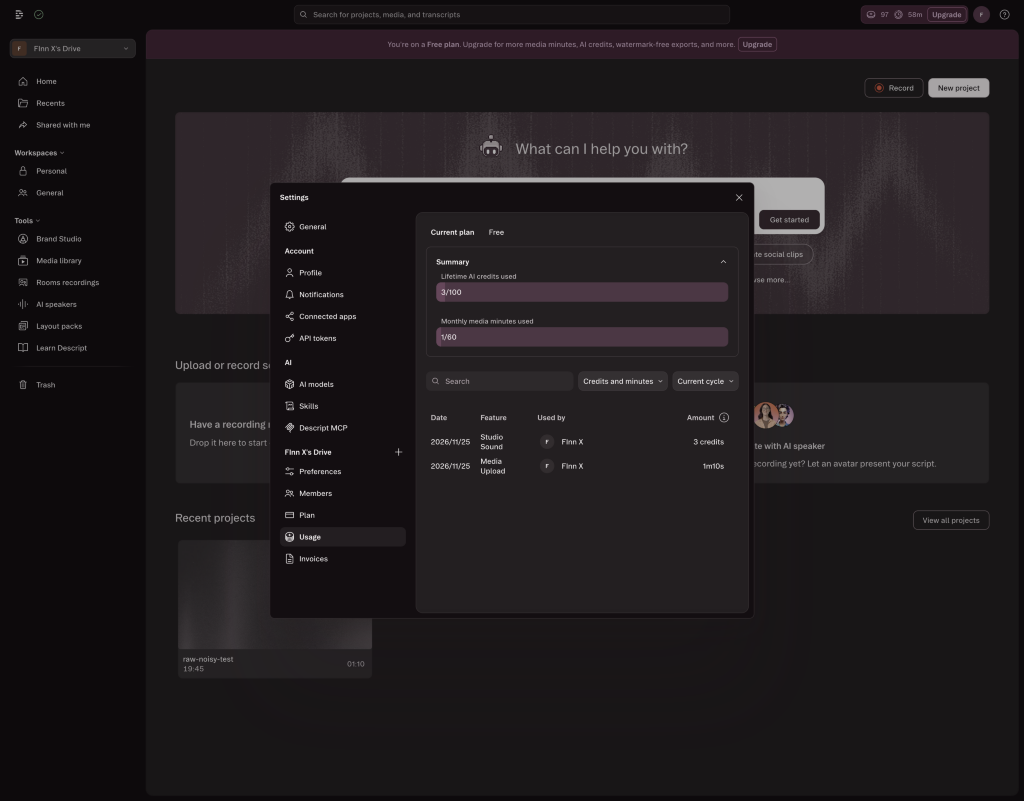 Descript’s usage log after running Studio Sound at 100% and testing the 75% slider: only 3 AI credits and 1m10s of media time were charged in total.
What This Means for Real Creator Budgets
- Short clips (1–5 minutes of YouTube Shorts, Loom demos, or ad reads): ElevenLabs is drastically faster to finish and easier to export. On the free 10,000-credit plan, you get 10 full minutes of clean
320 kbpsMP3 or lossless WAV audio with zero timeline setup. - Long podcasts (30–60 minutes per episode): Linear per-minute billing hurts ElevenLabs here—a single 60-minute podcast would burn
60,000credits. Descript’s dual-metered model (~2.57 AI credits/minon top of your monthly media minutes) scales much better for long-form episodes—provided you’re already on a paid plan that unlocks clean local/timeline exports.
Objective Acoustic Metrics & Waveform Comparison
To look past marketing claims, I ran all four tracks—original input, ElevenLabs output, Descript 100%, and Descript 75%—through an automated Python/FFmpeg acoustic script measuring the exact 0:16.15–0:17.85 silence window, integrated loudness (LUFS), True Peak, clipping samples, and the quiet 0:54–1:10 tail section.
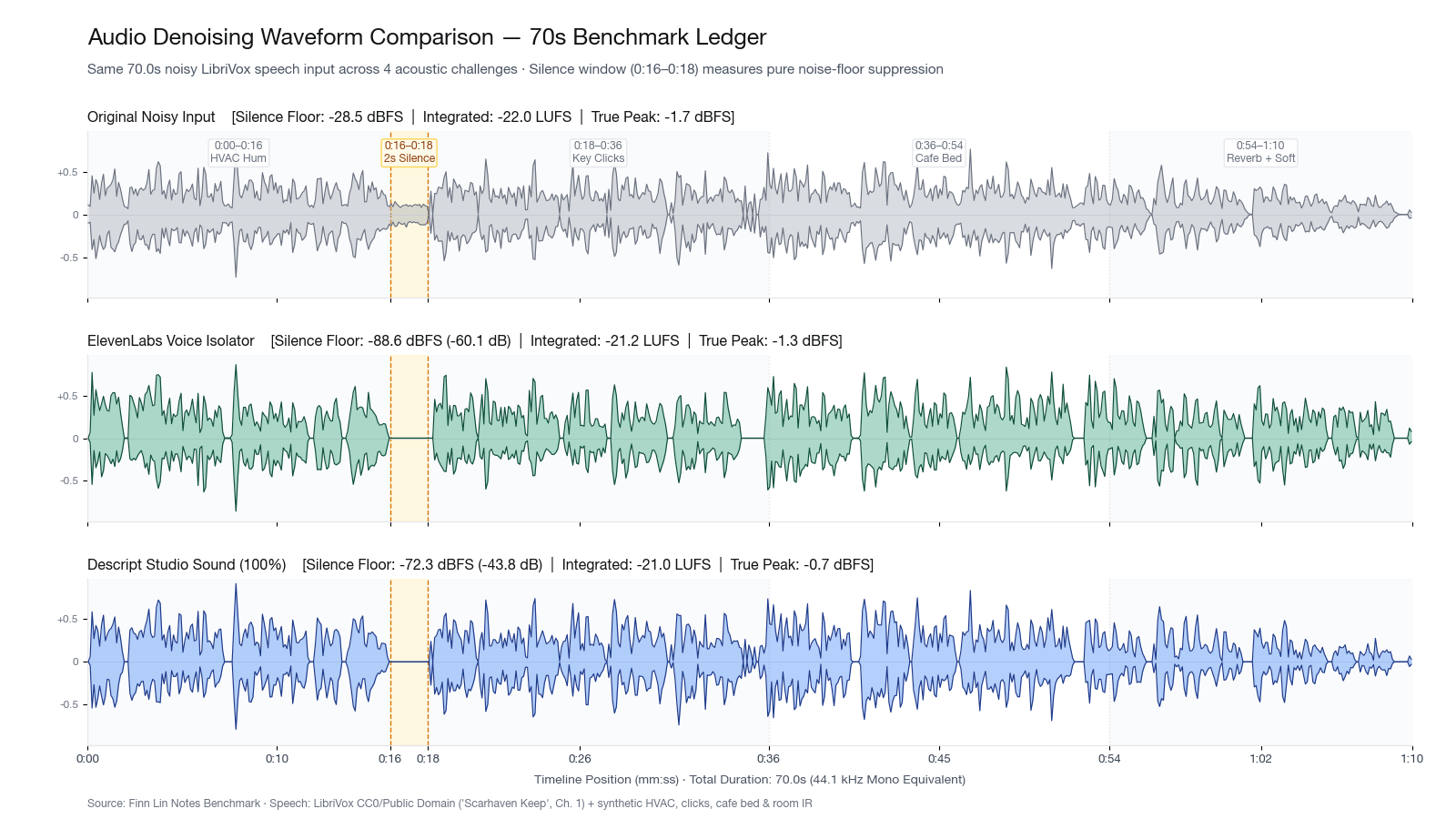 Waveform comparison across all four noise regions, highlighting the 2-second silence window (0:16–0:18) and quiet reverb tail (0:54–1:10).
Audio Track                  Silence Floor   Noise Drop   Loudness     True Peak   Clips   Region 4 RMS
-------------------------------------------------------------------------------------------------------
Original Noisy Input         -28.52 dBFS     Baseline     -22.0 LUFS   -1.7 dBFS   0       -24.16 dBFS
ElevenLabs Voice Isolator    -88.61 dBFS     -60.09 dB    -21.2 LUFS   -1.3 dBFS   0       -23.09 dBFS
Descript Studio Sound 100%   -72.32 dBFS     -43.80 dB    -21.0 LUFS   -0.7 dBFS   0       -25.34 dBFS
Descript Studio Sound 75%    -35.87 dBFS     -7.35 dB     -19.0 LUFS   +1.6 dBFS   37      -22.95 dBFS
Three Technical Details the Metrics Exposed
- ElevenLabs went 16.29 dB quieter without crushing soft endings: In the 2-second silence gap, ElevenLabs hit
-88.61 dBFS(essentially dead silent) compared to Descript100%’s-72.32 dBFS. At the same time, ElevenLabs kept the quiet reverb section (0:54–1:10) at-23.09 dBFS, whereas Descript100%pulled that section down to-25.34 dBFS—slightly more aggressive on soft trailing words. - Why Descript’s 75% slider is free—and risky on loud clips: Tweaking Descript’s slider from
100%to75%produced a brand-new audio hash without charging a single extra AI credit. The reason is clear in the numbers: the slider functions as a dry/wet mix, blending25%of the uncleaned original track back into the enhanced voice. That instantly brought the silence floor back up to-35.87 dBFS(only-7.35 dBcleaner than raw) and pushed overall loudness up by+2.0 LUFS, driving True Peak to+1.6 dBFSwith37clipped samples. If you dial back Descript’s slider for natural warmth, check your limiter or gain staging before publishing. - Zero clipping at 100% on both tools: Both ElevenLabs (
-1.3 dBFSTrue Peak) and Descript at100%(-0.7 dBFSTrue Peak) stayed safely below0 dBFSwith zero clipped samples.
Quick Acoustic & Workflow Takeaway
Looking at the waveform data alongside the export workflow, the practical trade-off is clear: ElevenLabs produces the cleaner black-background silence floor (-88.61 dBFS) while keeping soft spoken tails intact (-23.09 dBFS) and letting free-tier creators download lossless WAV/FLAC or 320 kbps MP3 in seconds. Descript at 100% delivers strong noise suppression (-43.80 dB) inside a full transcript-based timeline built for long-form episode editing—just avoid dialing the slider down to 75% on hot tracks without lowering clip gain first, and plan for a paid tier if you rely on frictionless local exports.
Updated 10,000-Credit ElevenLabs Free-Tier Ledger
Here is where my single 10,000-credit free ElevenLabs account stands after five hands-on benchmarks across four core features:
Feature Tested                            Credits Used   % of Free Pool
-----------------------------------------------------------------------
AI Dubbing (13-second clip)               3,294          32.9%
AI Sound Effects (full SFX session)       134            1.3%
TTS: Eleven v4 (2,726 chars / 3:13)       2,726          27.3%
TTS: Flash v2.5 Web UI check (115 chars)  115            1.2%
Voice Isolator (70-second audio clip)     1,167          11.7%
-----------------------------------------------------------------------
Total Spent                               7,436          74.4%
Remaining Balance                         2,564          25.6%
If you missed the earlier breakdowns, you can compare this against my 3,294-credit AI Dubbing test, my 134-credit AI Sound Effects test, and my Eleven v4 vs. Flash v2.5 Text-to-Speech ledger.
Verdict: Which One Should You Actually Use?
- Choose ElevenLabs Voice Isolator if you’re a solo creator cleaning short-to-medium clips (YouTube Shorts, tutorials, Loom walkthroughs, client voiceovers), want one-click lossless WAV or
320 kbpsMP3 downloads on the free tier, and want maximum noise-floor suppression (-60.09 dB) without touching a video editor. You can benchmark your own noisy clips on the free 10,000-credit tier by trying ElevenLabs here (affiliate link—supports more independent credit ledgers at no extra cost to you). - Choose Descript Studio Sound if you already edit 30-to-60-minute podcasts or talking-head videos inside Descript on a paid plan. Its per-minute AI credit burn (
~2.57 AI credits/min) is far friendlier to hour-long shows than linear per-minute billing—just keep Studio Sound at100%(or watch your peak gain if you lower the slider) and don’t expect frictionless exports on the free tier.
What’s Next on Finn Lin Notes
With 2,564 credits still left in my ElevenLabs test pool, I’m expanding the site beyond audio tools next: a full real-world credit ledger on Gamma’s 400 free AI presentation credits to see how many usable client decks a free account actually produces—and where regeneration silently drains your balance.
Editorial & Testing Note
Written by Finn Lin for Finn Lin Notes. All credit figures on this page come from hands-on testing under our 4-step benchmark protocol. Spot a pricing change or billing discrepancy? Send a ledger correction.